Lösung von Aufg. 8.2: Unterschied zwischen den Versionen
Aus Geometrie-Wiki
| (12 dazwischenliegende Versionen von 2 Benutzern werden nicht angezeigt) | |||
| Zeile 1: | Zeile 1: | ||
Beweisen Sie: Zu jeder Strecke <math>\overline{AB}</math> existiert genau eine Strecke <math>\overline{AB^{*}}</math> mit <math>\left| AB^{*} \right| = \frac{1}{\pi} \left| AB \right|</math> und <math>\overline{AB^{*}} \subset \overline{AB}</math>.<br /> | Beweisen Sie: Zu jeder Strecke <math>\overline{AB}</math> existiert genau eine Strecke <math>\overline{AB^{*}}</math> mit <math>\left| AB^{*} \right| = \frac{1}{\pi} \left| AB \right|</math> und <math>\overline{AB^{*}} \subset \overline{AB}</math>.<br /> | ||
| + | == Lösung --[[Benutzer:Schnirch|Schnirch]] 14:05, 14. Dez. 2010 (UTC) == | ||
| + | Voraussetzung: Strecke <math>\overline{AB}\subset AB^+ </math> <br /> | ||
| + | Behauptung: es existiert genau eine Strecke <math>\overline{AB^{*}}</math> mit <math>\left| AB^{*} \right| = \frac{1}{\pi} \left| AB \right|</math> und <math>\overline{AB^{*}} \subset \overline{AB}</math> <br /> | ||
| + | {| class="wikitable " | ||
| + | |+ Beweis | ||
| + | ! Nr. | ||
| + | ! Beweisschritt | ||
| + | ! Begründung | ||
| + | |- | ||
| + | ! style="background: #FFDDDD;"|(I) | ||
| + | | es ex. genau ein Punkt <math> B^* \in AB^+ </math> mit <math>\left| AB^{*} \right| = \frac{1}{\pi} \left| AB \right|</math> | ||
| + | | Axiom III.1 | ||
| + | |- | ||
| + | ! style="background: #FFDDDD;"|(II) | ||
| + | | <math>\overline{AB^{*}}</math> existiert und ist eindeutig | ||
| + | | (I), Def. Strecke | ||
| + | |- | ||
| + | ! style="background: #FFDDDD;"|(III) | ||
| + | | <math>\left| AB^{*} \right| < \left| AB \right|</math> | ||
| + | | Rechnen in <math> \mathbb{R} </math> und <math> \frac{1}{\pi} </math> < 1 | ||
| + | |- | ||
| + | ! style="background: #FFDDDD;"|(IV) | ||
| + | | <math> \operatorname{Zw} \left( A, B^*, B \right) </math> | ||
| + | | (I), (III), Def. Zw | ||
| + | |- | ||
| + | ! style="background: #FFDDDD;"|(V) | ||
| + | | <math>\overline{AB^{*}} \subset \overline{AB}</math> | ||
| + | | (IV) | ||
| + | |} | ||
| + | |||
| + | == vorangegangene Lösungsversuche und Diskussionen == | ||
<u>Vor</u>: <math>\overline{AB}</math> <br /> | <u>Vor</u>: <math>\overline{AB}</math> <br /> | ||
<u>Beh:</u> Es existiert <math>\overline{AB^{*}} </math>, <math>\left| AB^{*} \right| = \frac{1}{\pi} \left| AB \right| </math>,<math>\overline{AB^{*}} \subset \overline{AB}</math>.<br /> | <u>Beh:</u> Es existiert <math>\overline{AB^{*}} </math>, <math>\left| AB^{*} \right| = \frac{1}{\pi} \left| AB \right| </math>,<math>\overline{AB^{*}} \subset \overline{AB}</math>.<br /> | ||
| Zeile 13: | Zeile 44: | ||
4) <math>\pi</math> ist größer als 1. daraus folgt_____________________Rechnen in R<br /> | 4) <math>\pi</math> ist größer als 1. daraus folgt_____________________Rechnen in R<br /> | ||
| − | <math>\frac{1}{\pi} kleiner als 1 ist, daraus folgt wiederum \left| AB^{*} \right|</math> kleiner als <math>\left| AB \right|</math><br /> | + | <math>\frac{1}{\pi} kleiner als 1 ist, daraus folgt wiederum \left| AB^{*} \right|</math> kleiner als <math>\left| AB \right|</math><br /> |
5) Zw(A,B*,B)____________________________4)<br /> | 5) Zw(A,B*,B)____________________________4)<br /> | ||
| Zeile 19: | Zeile 50: | ||
6)<math>\left| AB^{*} \right|</math> + <math>\left| BB^{*} \right|</math>= <math>\left| AB\right|</math>_________Def. Zw 5)<br /> | 6)<math>\left| AB^{*} \right|</math> + <math>\left| BB^{*} \right|</math>= <math>\left| AB\right|</math>_________Def. Zw 5)<br /> | ||
| − | 7)<math>\overline{AB} | + | 7)<math>\overline{AB^{*}} :=(P\ Zw(A,P,B*))\cup (AB*)</math>________________Def. Strecke<br /> |
| + | |||
| + | 8)<math>\overline{AB}</math>:= <math>\overline{AB^{*}}\cup</math>(P\ Zw(B*,P,B)<math>\cup (B)</math> _____Def. Strecke<br /> | ||
| − | + | 9)<math>\overline{AB^{*}} \subset \overline{AB}</math>_________________________7) und 8) | |
| + | --[[Benutzer:Engel82|Engel82]] 17:55, 3. Dez. 2010 (UTC) | ||
| + | Die Lösung von Engel82 ist super ausführlich und auch korrekt!--[[Benutzer:Schnirch|Schnirch]] 14:04, 14. Dez. 2010 (UTC) | ||
| − | + | [[Category:Einführung_Geometrie]] | |
Aktuelle Version vom 14. Dezember 2010, 15:06 Uhr
Beweisen Sie: Zu jeder Strecke  existiert genau eine Strecke
  mit
mit 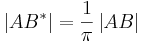 und
und 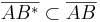 .
.
Lösung --Schnirch 14:05, 14. Dez. 2010 (UTC)
Voraussetzung: Strecke 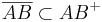
Behauptung: es existiert genau eine Strecke mit und
| Nr. | Beweisschritt | Begründung |
|---|---|---|
| (I) | es ex. genau ein Punkt  mit mit
|
Axiom III.1 |
| (II) | existiert und ist eindeutig
|
(I), Def. Strecke |
| (III) | 
|
Rechnen in  und und  < 1 < 1
|
| (IV) | 
|
(I), (III), Def. Zw |
| (V) |
|
(IV) |
vorangegangene Lösungsversuche und Diskussionen
Vor:
Beh: Es existiert , ,.
1)___________________laut Vor
2) es existiert ein Strahl AB+_________________Def. Strahl
3) es existiert genau ein Punkt B* auf_______________________Axiom vom Lineal
dem Strahl AB+ für den gilt:
4)  ist größer als 1. daraus folgt_____________________Rechnen in R
 kleiner als
5) Zw(A,B*,B)____________________________4)
6) +
+  = _________Def. Zw 5)
7) ________________Def. Strecke
8):=  (P\ Zw(B*,P,B)
 _____Def. Strecke
9)_________________________7) und 8)
--Engel82 17:55, 3. Dez. 2010 (UTC)
Die Lösung von Engel82 ist super ausführlich und auch korrekt!--Schnirch 14:04, 14. Dez. 2010 (UTC)